.png)


A new product is in the works — One that is focused on implementation. But I need your help ↓
Creative Alignment - Introduction
Creativity is the conduit for the activities that take place in a one-person business.
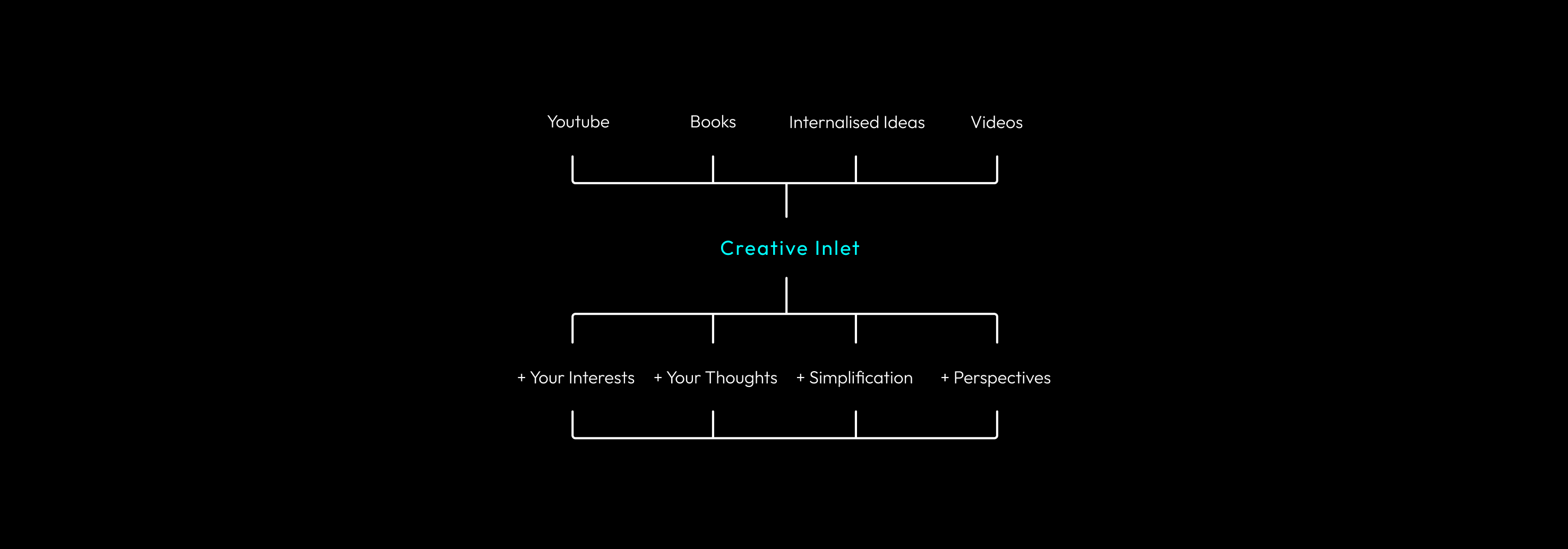
You may have seen a visual similar to this one below:
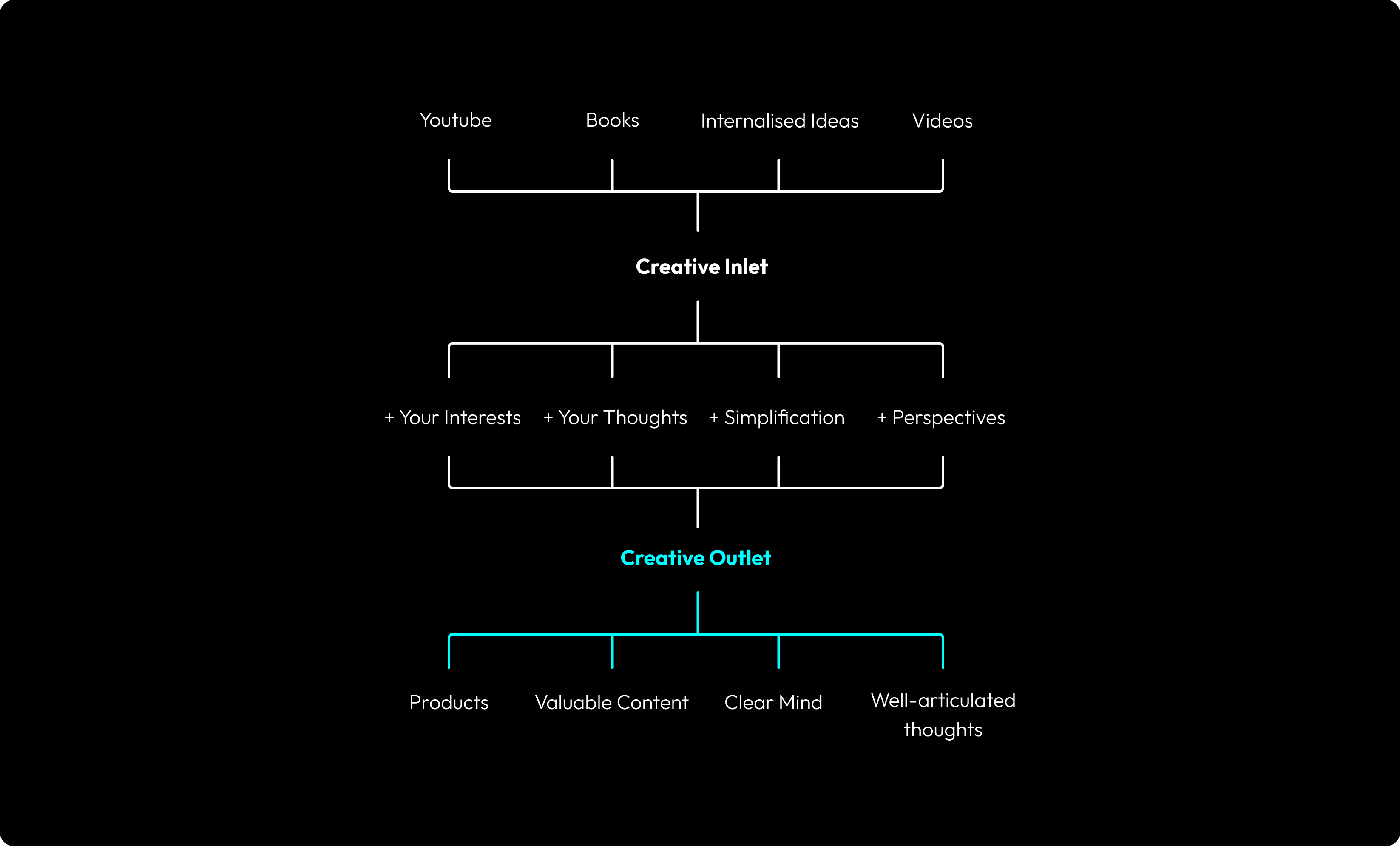
Creative Inlet plays hand in hand with creative input but there are differences.
Input is the act of putting something into something.
So inputting information into your mind is considered an input (which is primarily a verb).
Let’s take an analogy:
Take a box. The act of putting things into the box is considered input. The hole that allows the things to be put inside the box is the inlet.
Now coming back to your mind.
Your creative inlet has a filter at which the information is being transmitted. So you might get high-quality information, but your brain might not be able to actually make use of it properly.
This means that you may be unable the convey the words you hear into words you can think and use in your writing (as clearly)
This is the filter. So yes, the quality of the input definitely matters.. a lot. But I’d argue that the quality of your creative inlet is more important.
You may hear a lot of good things. But try putting what you hear into actual words you can use in your brand.
They will change and the way they change (either good or bad) depends on the quality of your creative inlet.
An idea is altered through its mistranslation into words.
Then it’s refiltered again through your audience’s lens and redistributed.
It’s an ongoing cycle.
So how do you improve that inlet in which information is being transmitted?
This guide will help you.
That’s what this whole guide is about.
The quality of the inlet at which you perceive information will dictate the quality of the outlet. Thus, directly affecting the work output.
Improving the quality of input is very easy. Just learn from higher-quality people.
Improving the quality of your creative inlet is something that can be taught.
Why? Because it’s a skill.
The following lessons will go into more depth but before that, I want to give you 3 concepts on creativity that have been very useful in my journey and hopefully, yours too.
1 - The first concept or state of mind I want you to develop is the abundance mindset.
The abundance mindset is more of a state of being.
Not necessarily a skill but a mere mindset shift.
The abundance state is the belief that the more ideas we put out in the world, the more that will arise back to you.
The more you share, the more your skill will improve and thus better ideas.
The abundance mindset is the opposite of the scarcity mindset.
Do not withhold the information you find valuable, in hopes of a better occasion. That better occasion will not come if you do not share that information you find valuable.
Scarcity leads to stagnation.
2 - The Experimenter and The Finisher
The creator business often leads to two different archetypes: the Experimenter and the Finisher.
Some parts of what you are going to read might not make sense just yet, but it will once you finish this whole guide.
The Experimenter thrives in the crafting and exploring phase, constantly generating new ideas and possibilities. However, they may struggle when it comes to releasing their work and bringing it to completion.
On the other hand, the Finisher excels at reaching the endpoint with clarity and efficiency but may lack the inclination for extensive experimentation in the earlier stages.
Both the Experimenter and the Finisher can benefit from embracing elements of the other's approach.
For the Experimenter, the emphasis lies in learning to bring their work to completion. While they excel at generating ideas and exploring various avenues, they may find it difficult to transition from the experimentation phase to the final execution. This can result in a backlog of unfinished projects or a reluctance to share their work with the world.
The Finisher can benefit from adopting a more experimental mindset. The Finisher moves to the end point with immediate clarity without too much experimentation in the earlier phases. This may limit their willingness to explore alternative paths and potentially discover even better solutions.
By incorporating elements of experimentation into their process, Finishers can open themselves up to new perspectives, insights, and creative breakthroughs. They can allocate time for brainstorming, idea generation, and trying out different approaches before settling on a final outcome.
There should be a balance between exploration and completion.
3 - The third concept is intention.
The intention at which you do things matter. More focused attention yields greater care and love by those who use it.
Intentions ≠ Goals - Intention is the sole reason why you are creating something. it’s almost like an energetic charge.
Zoom in and obsess. Zoom out and observe - Rick Rubin
Click the button below to move on to the next lesson - Idea Generation ↓